
Listen on Spotify
Listen on Apple Podcasts
A mystery buried beneath the ice
It began as a simple NASA experiment, a scientific mission high above the frozen world of Antarctica. But what the ANITA balloon detected deep beneath the ice wasn’t supposed to exist. From far below the continent’s solid rock, strange radio signals began rising toward the sky, traveling in ways that defy the basic laws of physics.
These signals didn’t just surprise researchers—they shook the foundations of particle science itself. The discovery, first made in 2016 and confirmed on later flights, revealed a mystery that continues to puzzle physicists, astronomers, and conspiracy theorists alike.
Listening to the unknown
The experiment, known as ANITA (Antarctic Impulsive Transient Antenna), was designed to hunt for one of the universe’s most elusive particles: the neutrino. These ghost-like particles pass through matter almost undisturbed. Trillions of them stream through your body every second, invisible and harmless.
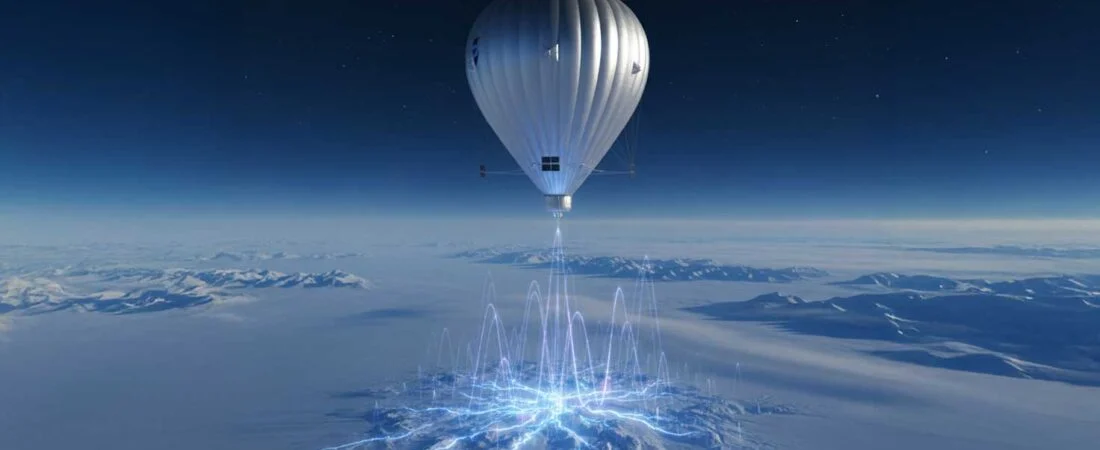
To detect them, NASA’s ANITA array floated beneath a massive helium balloon more than 25 miles above the ice. From that height, it scanned the continent for the faint radio flashes created when high-energy neutrinos strike atoms in the Antarctic ice. Each flash, each “ice shower,” is a signal from deep space—a cosmic fingerprint of violent events like supernovas and black holes.
But one day, ANITA heard something else.
The anomaly
The radio waves it detected weren’t coming down from the cosmos as expected. They were coming up—from below the surface. Strong, clear signals appeared to rise through the rock and ice, cutting upward at angles that no known particle or wave could survive.
To understand how strange this is, imagine trying to get a cell phone signal while trapped in a concrete bunker under a mountain. Radio waves simply can’t make that journey. Yet somehow, these signals did.
The physics is clear: a radio burst coming from 30 degrees below the horizon should have been absorbed long before reaching ANITA’s detectors. But the balloon heard it anyway.
Breaking the laws of physics
The discovery forced scientists into a difficult choice. Either there exists a new, unknown particle capable of passing through thousands of kilometers of rock and ice, or there’s a massive gap in our understanding of how radio waves move through Earth’s crust.
For a brief moment, the physics community was electrified. Could ANITA have discovered a new type of neutrino, something outside the Standard Model of particle physics? A “sterile neutrino” perhaps—one that doesn’t interact with ordinary matter at all? Or was this the first tangible sign of dark matter, the invisible substance believed to make up most of the universe?
If true, it would have rewritten physics textbooks overnight.
The follow-up
Science, however, demands proof. Researchers turned to two other powerful detectors: the Pierre Auger Observatory in Argentina and the IceCube Neutrino Observatory buried at the South Pole. These massive instruments can detect high-energy particles from cosmic sources. If ANITA had indeed captured something revolutionary, IceCube or Auger should have seen a matching event.
After digging through more than 15 years of data, they found nothing. No confirmation. No duplicate signal. Just silence.
This was a crushing blow to the theory of new physics. Without independent evidence, the “new particle” hypothesis grew weaker. Still, the signal was undeniably real. The data was solid. So what could cause it?
A glitch in the ice
Today, scientists are leaning toward a more grounded but equally fascinating explanation. They suspect an unknown environmental effect, something specific to Antarctica itself.
The idea is that under rare conditions, radio waves might bend, refract, or tunnel through layers of dense ice and atmosphere in a way that current models can’t predict. In other words, there could be a quirk in how electromagnetic energy behaves near the horizon—a kind of frozen mirror effect that makes signals appear to come from impossible directions.
If that’s true, then Antarctica might be hiding an entirely new kind of natural phenomenon. Not alien technology or ghost particles, but a rare Earth-based trick of physics that we’ve never seen before.
The next step: PUEO
To solve the mystery, NASA is building ANITA’s successor. The new mission, called PUEO (Payload for Ultrahigh Energy Observations), is being engineered to detect even fainter signals with higher precision. Its massive antenna array will scan deeper, record cleaner data, and perhaps finally reveal what’s hiding under all that ice.
If the PUEO mission confirms that these strange upward radio waves are caused by environmental effects, it will expand our understanding of radio physics and the behavior of energy in extreme conditions.
But if it doesn’t—if PUEO detects the same unexplained bursts and rules out every known cause—then science will once again find itself staring into the unknown.
A riddle that won’t fade
For now, the signals remain anomalous, a polite scientific word for unexplainable. The data hasn’t gone away, and the questions keep coming. Could these be the echoes of some long-buried geological process? A previously unseen cosmic event bouncing off the planet’s interior? Or is something deeper stirring beneath the Antarctic ice?
When the natural world produces something that seems impossible, it’s often a sign that discovery is close.
Perhaps, just below the ice sheet, the Earth is whispering a secret we haven’t yet learned how to hear.