
Listen on Spotify
Listen on Apple Podcasts
Celestial visitors or cosmic impostors?
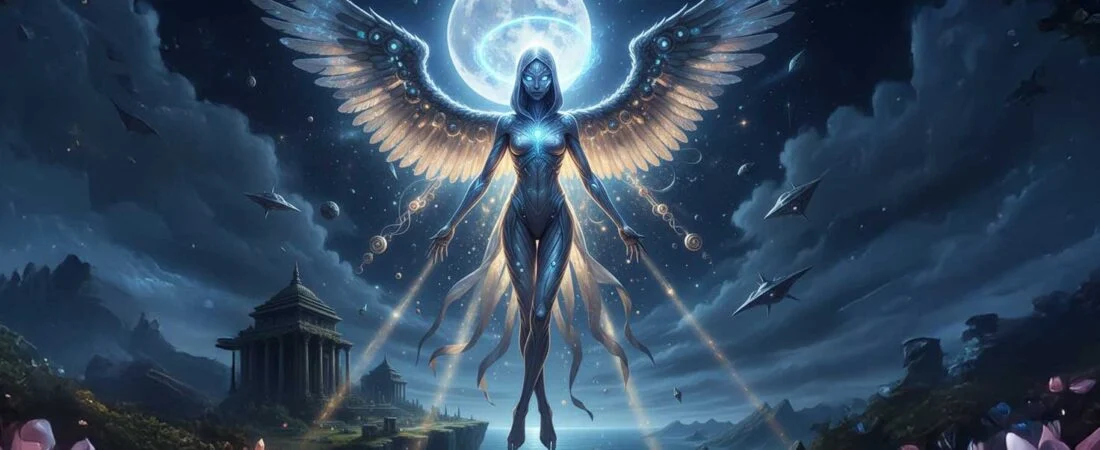
For centuries, humanity has looked to the heavens for guidance and protection. Stories of radiant beings descending from the sky are found in every culture—angels bringing messages of light, demons spreading chaos and fear. But what if these entities aren’t supernatural at all? What if they’re extraterrestrial?
As strange as it sounds, modern researchers and theologians alike are revisiting ancient scriptures through the lens of UFO phenomena. The question they’re asking is unsettling: could angels and demons be visitors from other worlds, misinterpreted through the language of faith and myth?
Ancient texts and modern parallels
In the Book of Ezekiel, written nearly 2,600 years ago, the prophet describes seeing “wheels within wheels” in the sky, surrounded by flashes of lightning and beings radiating light. To ancient witnesses, this was divine. But to some modern ufologists, it reads like an account of a mechanical craft—an advanced vehicle piloted by non-human intelligence.
The parallels don’t stop there. Hindu scriptures such as the Bhagavad Gita describe vimanas, flying chariots used by gods for travel and battle. Ancient Sumerian carvings show winged beings descending from the heavens. Even the Book of Genesis mentions the Nephilim, said to be the offspring of “the sons of God” and human women—a concept that eerily resembles the alien hybridization theories of today.
Throughout history, cultures across the globe seem to echo the same story: beings from above who influence humanity’s destiny.
The darker side of the sky
If angels can be reinterpreted as benevolent extraterrestrials, what about their opposites—the demons?
Descriptions of demonic possession and alien abduction share a surprising number of traits. Victims report paralysis, missing time, strange marks on the body, and terrifying encounters with non-human entities. In both cases, there’s often telepathic communication, bright light, and overwhelming dread.
Dr. Elaine Moretti, a mythologist who studies the intersection of folklore and extraterrestrial accounts, explains: “Across time, people describe the same basic experiences—contact with beings who manipulate their senses, alter their perception of time, and seem to have power over physical reality. The names change, but the pattern stays the same.”
Are we facing the same phenomenon through different cultural filters—angels in one age, aliens in another?
Signs written in stone and scripture
Art and archaeology add another layer to the mystery. From cave carvings in Australia to Mayan reliefs in Central America, ancient artists often depicted beings with elongated heads, halos of light, or flying discs overhead. Renaissance paintings show glowing orbs in the sky, sometimes near biblical scenes.
Were these merely symbolic representations—or attempts to document real encounters with something unexplainable?
Some historians caution that ancient people used metaphorical language to describe spiritual experiences. But others argue that, taken together, the global consistency of these images points to a shared memory of actual events—contact that spanned civilizations and epochs.
The psychological connection
In the 1950s, psychologist Carl Jung wrote about flying saucers as a new kind of myth—a modern expression of the same archetypal need that once produced angels and demons. To Jung, UFOs weren’t necessarily spacecraft, but symbols of humanity’s desire for transcendence and meaning in an age of science.
Modern psychology builds on that idea, suggesting that both divine visions and alien encounters might arise from altered states of consciousness, sleep paralysis, or neurological anomalies. In this view, angels and demons—and even aliens—are reflections of the human psyche grappling with the unknown.
Still, as abductees and witnesses insist, psychological explanations don’t account for everything. Some encounters leave behind physical traces—radiation burns, radar confirmation, and synchronized sightings by multiple observers.
Religion’s defense
Not everyone welcomes the extraterrestrial reinterpretation of the sacred. Father Henry Valdez of St. Dominic’s Cathedral in San Antonio argues that equating angels and demons with aliens reduces profound spiritual truths to mere material phenomena.
“Angels and demons exist outside physical reality,” Valdez explains. “They are part of the moral and spiritual dimensions of creation, not its technological ones. Aliens, if they exist, are biological creatures like us—part of God’s universe, not His messengers.”
To him, calling angels aliens is like mistaking the divine for the mechanical—a confusion of purpose and meaning.
Bridging faith and physics
Yet many scientists and theologians find common ground in curiosity. Both religion and science ask the same fundamental question: Where do we come from?
If non-human intelligences have visited Earth for millennia, as some UFO researchers claim, then ancient texts might represent humanity’s earliest attempts to record those encounters. The miracles of the past could be the science of another civilization, filtered through human interpretation.
As Dr. Moretti puts it, “Whether we call them angels, demons, or aliens, these entities remind us that we’re not alone—and that something beyond our understanding has been interacting with us for a very long time.”
Real-world encounters
Modern sightings continue to fuel this theory. Reports of glowing figures descending from the sky or humanoid beings delivering cryptic messages sound eerily similar to biblical accounts of angelic visitations. Conversely, the chilling aspects of some abduction stories—control, fear, and manipulation—echo descriptions of demonic oppression.
Even cases like the Betty and Barney Hill abduction in the 1960s carry parallels to medieval “night visitors” who punished or enlightened humans. In rural Brazil, sightings of winged, glowing creatures attacking livestock have drawn comparisons to both the Chupacabra and biblical demons.
The names change. The fear—and the fascination—do not.
The cosmic question
So, are angels and demons truly beings of spirit and faith—or ancient extraterrestrials who inspired our earliest religions? The evidence is ambiguous, scattered across scripture, art, and modern witness accounts.
Perhaps these forces are both physical and metaphysical, occupying a space where science and spirituality meet. If angels are messengers, maybe their message has been the same all along: that the universe is more complex, more alive, than we dare imagine.
Whether they come from heaven or another star system, one thing is certain—they’ve been watching humanity for a very long time.