
Listen on Spotify
Listen on Apple Podcasts
Imagine waking up in the dead of night, unable to move or scream. Your limbs limp, lungs struggling for breath, and what’s worse—a presence in the room. It’s not just a nightmare: millions experience this “sleep paralysis” every year, and the reality is far scarier than any nightmare.
Across cultures and centuries, sleep paralysis is often seen as a supernatural attack. In the Canadian Inuit tradition, it’s believed to be the work of powerful shamans sending spirits to torment the sleeper. In Japan, a vengeful ghost suffocates enemies as they rest. In the rural Southern United States, an entity known as “the hag” visits at night, foreshadowing tragedy or death. Some even say being paralyzed by a “hag” is a warning of imminent disaster.
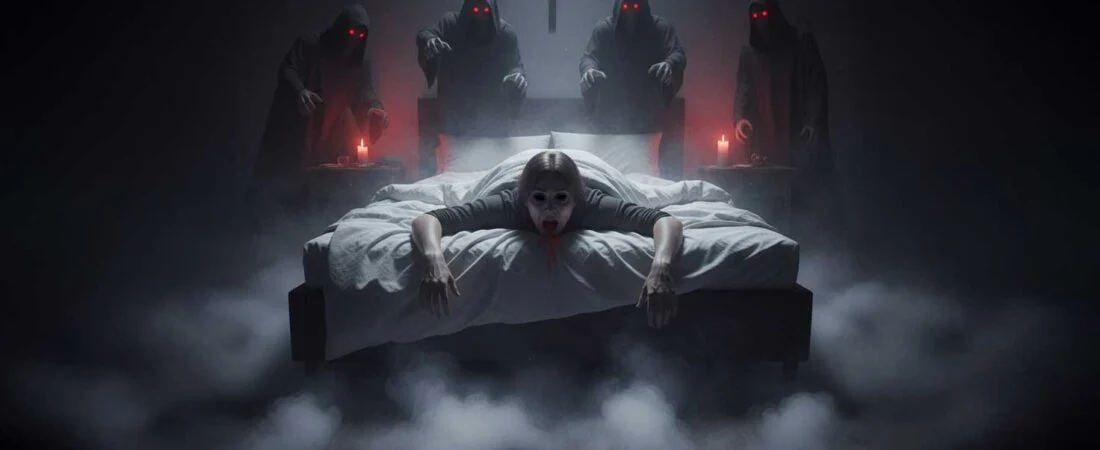
The stories are disturbingly consistent. A reported 1 in 5 people worldwide experience paralysis in sleep, usually in the hour before dawn. The victim opens their eyes but finds themselves frozen—utterly helpless. Shadowy figures lurk in the corners; red-eyed demons, horned beasts, or faceless spirits sometimes approach and sit on your chest, pressing the breath from your body. Others see twisted shapes, ghostly limbs, or even themselves floating above their bed in an out-of-body sensation.
Some victims recall being physically attacked—a sinister clown figurine wrapping its wire arms around their neck, a monstrous hag pounding their chest, or the ghostly apparition of a loved one who cannot be reached or called. The worst part is knowing you can’t move, scream, or run. Real stories recount panic, suffocation, and the bone-chilling certainty that this paralysis is not simply in the mind, but a visitation from some other world.
While science describes the phenomenon as the accidental collision of REM sleep and wakefulness—leaving the body frozen and hallucinations triggered by neurochemical imbalance—many are convinced the truth is darker. Nearly 40% who experience sleep paralysis see spirits, demons, or supernatural beings. Centuries-old accounts, and haunted folklore, suggest these encounters are not coincidences but a window to another realm.
There are rare cases where paralysis strikes in a haunted house, following a séance, or after days spent researching the paranormal. The “San Antonio Disturbances,” described in recent research, showed that stress and belief in the supernatural heightened the risk of episodes. In these cases, paralyzed individuals reported not just generic spirits, but encounters with ghosts tied to a location—a spectral woman, a spectral beast, or an entity known only by its chilling, silent stare.
For some, paralysis is merely a night terror. For others, it is proof of the supernatural—proof the veil between the worlds, and the body, can be breached, leaving victims gasping for breath in the grip of something ancient and unseen.
So tonight, as you close your eyes, remember: the scariest hauntings are the ones where you are awake, and completely unable to move.