
Listen on Spotify
Listen on Apple Podcasts
Most people look up at the night sky when they wonder about danger from space. Meteor strikes, solar flares, rogue objects drifting in the dark. But sometimes the threat does not come from above. Sometimes it comes from right beneath our feet.
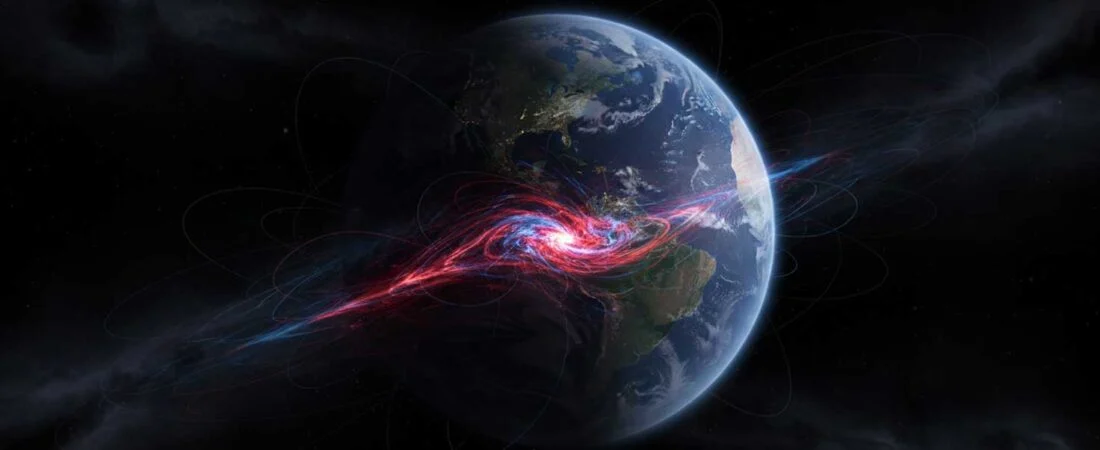
NASA has been tracking a strange and growing phenomenon inside Earth’s magnetic field. It is a massive weak spot called the South Atlantic Anomaly. The region stretches across Brazil, Argentina, and the southern Atlantic Ocean. And in recent months, scientists have quietly admitted that the anomaly is growing in size and behaving in ways they do not fully understand.
Earth’s magnetic field is supposed to protect us. It shields the planet from harmful cosmic radiation, solar storms, and charged particles that could wipe out our satellites and power grids. So when that invisible shield weakens, even slightly, scientists pay close attention.
But the South Atlantic Anomaly is not just weak. It is getting weaker every year, splitting into multiple patches, and expanding outward as if something deep inside Earth is shifting. NASA uses satellites and magnetometers to monitor it. And what they are finding is making researchers nervous.
A magnetic field is only as strong as the spinning molten iron in Earth’s core that generates it. When that flow changes, the field changes. But the pattern happening now does not match the usual fluctuations scientists expect. Instead of drifting predictably, the anomaly has been wobbling and branching into new zones.
Some researchers believe the outer core beneath South America contains a region of unusually dense material that is interfering with the magnetic flow. Others think the anomaly could be a sign of the magnetic poles slowly preparing to flip, something Earth has done many times across its history. It is a natural process, but one that can be chaotic and disruptive for modern technology.
But there is also a quieter theory. One NASA scientists mention only in interviews and conference talks. What if something deeper is interacting with the field in ways we do not yet understand?
The South Atlantic Anomaly first became a problem in the 2010s. Satellites passing through the region had their instruments glitch or reset. One satellite lost its entire memory cache. Astronauts aboard the International Space Station report increased radiation exposure when they orbit through the weak zone. They see bright flashes of light behind their eyelids as cosmic rays pass through their retinas.
This is normal inside the anomaly. But the anomaly itself is not acting normally.
In the past few years, NASA has detected that the weak patch is not only spreading but intensifying. The field strength inside the anomaly has dropped even lower than expected. It is now so weak that scientists describe it as a dent in the magnetic shield.
And dents tend to get worse, not better.
Some geophysicists worry that if the anomaly becomes too unstable, it could disrupt GPS systems, disable satellites, and expose aircraft to elevated radiation. A strong solar storm hitting Earth while the anomaly is unstable could cause widespread blackouts and communication failures.
But there is another angle that has captured the attention of researchers studying unexplained phenomena. Changes in magnetic fields have long been associated with strange atmospheric and electrical behavior. Some scientists have proposed that magnetic anomalies could affect radar signatures, electrical systems, and even human perception.
For decades, UFO sightings have clustered around regions where magnetic fields behave oddly. The Bermuda Triangle. The Alaska Triangle. Certain regions in Brazil. And now, once again, we find a magnetic mystery centered over the southern Atlantic.
No one is claiming the anomaly is caused by anything unnatural. But the correlation between magnetic instability and strange phenomena is something researchers in multiple fields have tracked quietly for years.
When Earth’s shield wavers, the world becomes more vulnerable. More unpredictable. And more likely to experience the unusual.
Another unsettling detail emerged recently. The anomaly seems to be splitting into two separate weak zones. This splitting effect is something scientists did not predict. Normally, a weak spot spreads or fades. It does not divide like a cell. But current models show two distinct regions slowly drifting apart, like cracks forming in glass.
Satellite engineers are already modifying flight paths to avoid the anomaly when possible. Future spacecraft designs may require additional shielding to withstand the radiation spikes inside the growing weak zone.
And then there is the pole flip theory. Earth’s magnetic field reverses roughly every few hundred thousand years. North becomes south. South becomes north. It is not instant. It is a slow collapse and rebuild. During the transitional period, multiple magnetic poles can appear at once. The field can weaken dramatically. Radiation levels rise. Migratory animals lose their navigation abilities. Technologies we rely on become unstable.
Some geologists believe we are overdue for such a reversal.
They also believe the anomaly could be the first real sign of it.
NASA has publicly stated that we are not facing an immediate catastrophe. The anomaly is concerning but manageable. Satellites can be reinforced. Data can be corrected. Navigation systems can be recalibrated. Earth has survived magnetic chaos before.
But privately, several researchers have admitted the same thing.
The anomaly’s behavior is not following historical patterns. Something unusual is happening inside Earth’s magnetic engine.
Whether it is a natural fluctuation, the beginning of a pole shift, or something stranger affecting the flow of energy inside the planet, one fact remains.
Earth’s shield is changing. And no one knows exactly why.
As NASA continues to track the anomaly, the rest of the world watches and waits. Because when Earth’s magnetic field moves, the consequences ripple through everything we rely on. And if the anomaly keeps growing, the invisible barrier that protects us may become thinner than we ever expected.