
Listen on Spotify
Listen on Apple Podcasts
Across the vast distances of our solar system, radio noise drifts endlessly. Static, magnetic storms, cosmic rays, the hum of the universe itself. Most of it is nothing more than background chaos. But every so often, buried deep in that cosmic whisper, something structured appears. Something patterned. Something that suggests intention.
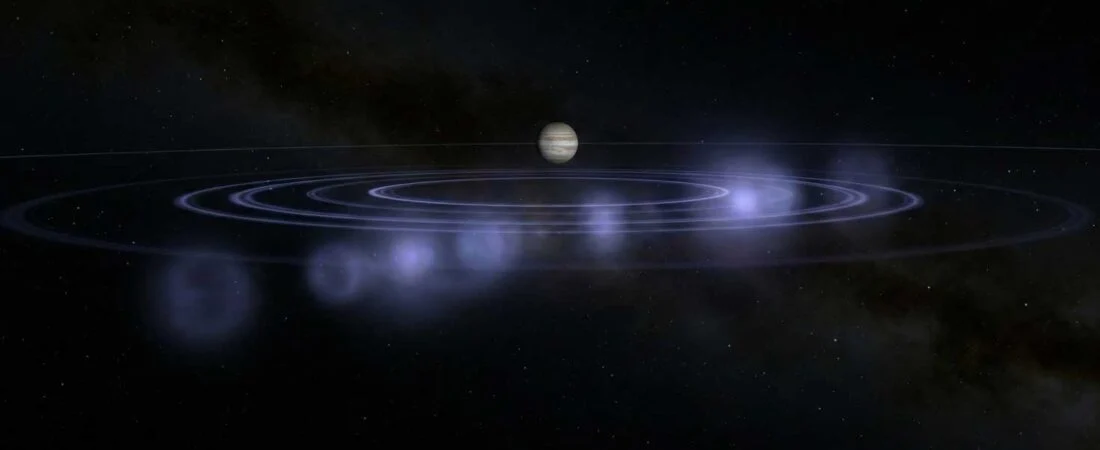
And recently, astronomers listening near Jupiter’s orbit detected a signal unlike anything they expected.
It began quietly. A faint pulse that appeared only once in a span of several hours. Researchers marked it as an anomaly. Perhaps interference. Perhaps equipment drift. Nothing unusual. But then the pulse repeated again. And again. Resetting every 20 minutes with uncanny precision.
A structured burst of noise.
A pause.
Exactly 20 minutes.
Another burst.
Perfectly timed.
This alone was strange. Space is chaotic. Natural signals rarely behave with mechanical consistency. But what captured the attention of researchers wasn’t just the timing. It was the structure inside the burst.
One astronomer described it as “organized static,” a pattern that didn’t resemble any known satellite, probe, or natural planetary emission. The signal seemed too deliberate, too controlled. And its strength was surprising. Not powerful in volume, but unusually stable. As if whatever was producing it held its position with incredible precision.
The first suspicion was obvious: a malfunctioning spacecraft. But every known probe orbiting or passing near Jupiter was accounted for. Every transmitter was silent or operating normally. None were broadcasting anything like the repeating 20 minute pattern.
The next thought was Earth based interference. That was ruled out quickly. The signal’s delay and Doppler shift matched a deep space origin. Its drift was consistent with something moving in Jupiter’s general region, not anything on or near Earth.
So the team turned to natural explanations. Jupiter is a loud planet, radiowise. Its massive magnetic field blasts out complex emissions. But the newly detected pattern did not match Jupiter’s well documented radio storms. It was cleaner. More focused. And far too rhythmic.
One researcher pointed out that the signal lacked the swirling harmonics typical of Jovian activity. Instead, it resembled a beacon. A repeating marker. A time stamped pulse.
This is where the scientific debate began to shift from ordinary to unsettling.
If the source was natural, why was it repeating with machine like precision?
If it was artificial, who or what put it there?
Some scientists suggest that the signal could come from an object orbiting Jupiter, perhaps something small, metallic, and tumbling in space. As it rotates, it might reflect radio waves in a rhythmic pattern. But this theory has problems. The timing is too exact. Too stable. And no known debris or relic has produced a pattern like this before.
Others believe it could come from a previously unknown astrophysical phenomenon. Perhaps charged particles interacting with Jupiter’s magnetosphere in a way we have never seen. But this still does not explain the tight, clock like consistency.
There is also a small but growing group who whisper about a more dramatic possibility.
A probe.
Something ancient.
Something abandoned.
Something still active.
It would not be the first time scientists speculated that old alien technology could be drifting silently through our solar system. Some think objects like Oumuamua may be remnants of ancient technological activity. The idea is not mainstream, but it is gaining traction among researchers who study anomalous signals.
But even the probe theory raises questions. If something artificial is broadcasting a repeating pulse, why here? Why near Jupiter? And why now? Is it a damaged transmitter? A malfunctioning engine? A beacon to something far away? Or simply the cosmic equivalent of a ghost light flickering in the dark?
Then there is the location of the signal. Its source is not precisely known, but its drift suggests it is coming from a region trailing behind Jupiter’s orbit, an area rich with small asteroids and Trojans. If an object wanted to hide, that is one of the best places in the solar system to disappear.
Several astronomers argue that if anything artificial were placed in the outer solar system millions of years ago, the Trojan regions are where they would naturally end up. Stable. Protected. Hard to detect unless you are listening closely.
And now we are.
The repeating signal has generated excitement far beyond the observatory. Radio engineers, astrophysicists, and SETI researchers are all attempting to model the pattern. Some swear they see mathematical structure inside the burst. Others insist the burst is random noise shaped by unknown natural forces.
One researcher described the pattern as “too orderly to ignore, too simple to interpret.”
But the most chilling theory is the one whispered behind closed doors. The idea that the signal might not be aimed at Earth at all. It might be communicating with something else in our solar system. Something we have not yet detected.
In this scenario, we are not the receivers.
We are eavesdropping on a conversation never meant for us.
While most experts reject that idea, they admit one unsettling fact: whatever is producing the signal seems to be moving. Slowly. Purposefully. Its Doppler shift suggests a path that does not match any known orbit. It is drifting, changing position over days.
Natural objects drift.
But do they broadcast repeating, timed pulses?
Some astronomers are pushing for deeper observation. Point more dishes at the region. Use higher resolution arrays. Search for a source. But the signal’s faintness makes pinpointing the origin difficult. The burst is barely above the background noise of space. That makes it both easy to miss and hard to locate.
Still, the fact remains: something near Jupiter is broadcasting a pattern. Not noise. Not chaos. A pattern. And nothing in our current catalog of natural phenomena fits perfectly.
For now, the official description is “an unidentified repeating radio event from the Jovian region.” But off the record, many scientists admit they have never seen anything quite like it.
As the search continues, the signal keeps pulsing.
On.
Off.
Twenty minutes.
Repeat.
And tonight, we ask the question at the center of every mystery.
If someone out there is sending a message, are we finally beginning to hear it?