
Listen on Spotify
Listen on Apple Podcasts
When a comet streaks through our solar system, most of us picture something ancient, icy, and beautiful. But Comet 3I/ATLAS has become something very different. It has turned into the center of a worldwide alert, a growing mystery, and now a full-scale planetary-defense exercise ordered by the United Nations and the International Asteroid Warning Network.
The announcement caught many off guard. On television screens, social media feeds, and YouTube channels, the same message appears in bold letters:
Comet 3I/ATLAS is now the target of a global defense exercise from November 27, 2025 through January 27, 2026.
For most space objects, this type of response never happens. So why this comet, and why now?
What makes 3I/ATLAS so unusual is that it doesn’t behave like a normal comet. Astronomers have been tracking its movement since its discovery, and something about it refuses to fit into the neat equations of orbital mechanics. Its speed shifts in ways no one fully understands. Its path bends slightly off predictable trajectories. And recently, amateur astrophotographers have reported strange light signatures that do not line up with any known natural behavior.
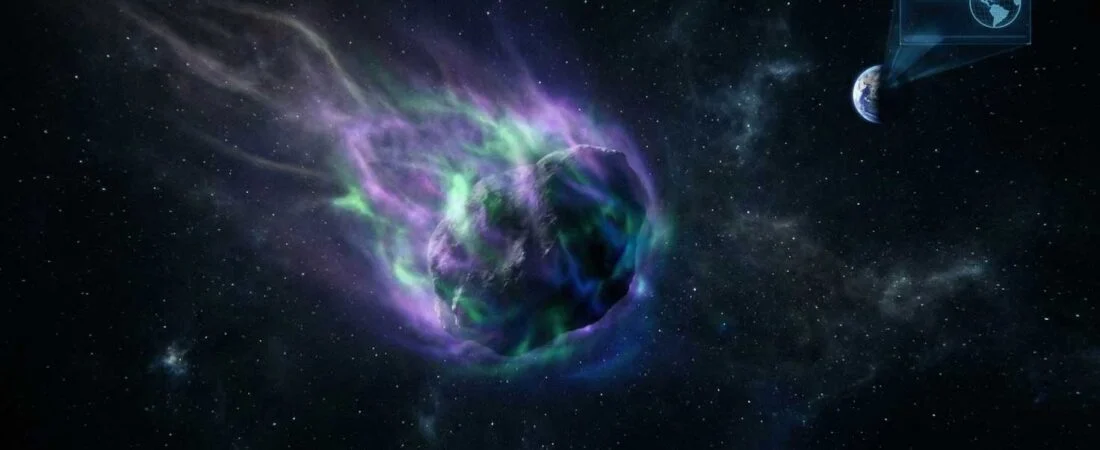
One YouTube video in particular has taken the internet by storm. The creator claimed to have captured new images of 3I/ATLAS through his telescope. The photos looked nothing like the smooth glowing tails seen in standard comet photography. One image showed a bright, vibrant purple core surrounded by a hazy sphere of energy. Another showed a greenish blur with a sharp white point emerging from one edge, almost like something was moving inside it.
Whether the color distortions came from camera sensors, atmospheric effects, or something more unusual is still unknown. But the images sparked a wave of online discussion. Thousands of viewers wondered whether the comet was simply reflecting unexpected wavelengths of light—or if something else was happening inside that traveling mass of ice and dust.
The timing of the UN announcement only fueled the mystery. Planetary-defense exercises do happen, but rarely with such a specific target. And almost never this publicly.
According to official statements, the exercise is meant to simulate a coordinated international response in case a hazardous object were ever on a collision course with Earth. But nowhere in the announcement does it claim 3I/ATLAS is dangerous. The language is cautious, vague, and oddly formal. The message feels like a warning without ever calling itself one.
Scientists interviewed on major news outlets offer a mix of reassurance and uncertainty. Some explain that unusual comet movement can happen when frozen gases suddenly evaporate and push the object sideways, a natural jet-like effect. Others admit that 3I/ATLAS has shown more variation than normal, and they cannot fully explain the light fluctuations reported by independent observers.
At the same time, online communities that follow UFO sightings and space anomalies have taken special interest. To them, the combination of amateur images, strange illumination, and a multinational defense response feels too coincidental. They see this as the most significant space anomaly since the object known as 1I/‘Oumuamua, which also showed unexplained acceleration that could not be linked to its size or shape.
Even mainstream viewers admit something feels off. If this were only a drill, why does it revolve around an object already known for unpredictable behavior? And why have several space agencies increased their tracking frequency without much explanation?
The growing tension around 3I/ATLAS is not only scientific. It’s emotional. People feel the quiet worry beneath the official statements, the sense that something rare is happening out in the darkness of space—something we may not be fully prepared for.
The comet will be at its closest approach in the coming weeks. Telescopes across the world are turned toward it every night. Some astronomers report that its brightness fluctuates more than expected, almost pulsing, while others dismiss these claims as equipment quirks. But everyone agrees on one thing: 3I/ATLAS is worth watching.
Whether the global exercise is purely precautionary or a hint at deeper concerns, we may not know for a while. For now, the comet continues to glide across the void, carrying its secrets with it. Colorful images and unusual data points leave us with more questions than answers.
Is this comet simply a strange visitor from another region of space? A chunk of ice behaving oddly as it warms? Or is it something far more significant—an object whose nature we still do not understand?
As the exercise unfolds and more images surface, the world waits. The light from 3I/ATLAS grows stronger each night, and with every new observation, the mystery deepens.
Space has always offered more questions than answers, but this time, the eyes of the entire planet are locked on a single point in the sky. And whatever 3I/ATLAS truly is, the next few months may decide whether it becomes a scientific curiosity—or a historic turning point in our understanding of what moves through the cosmic dark.