
Listen on Spotify
Listen on Apple Podcasts
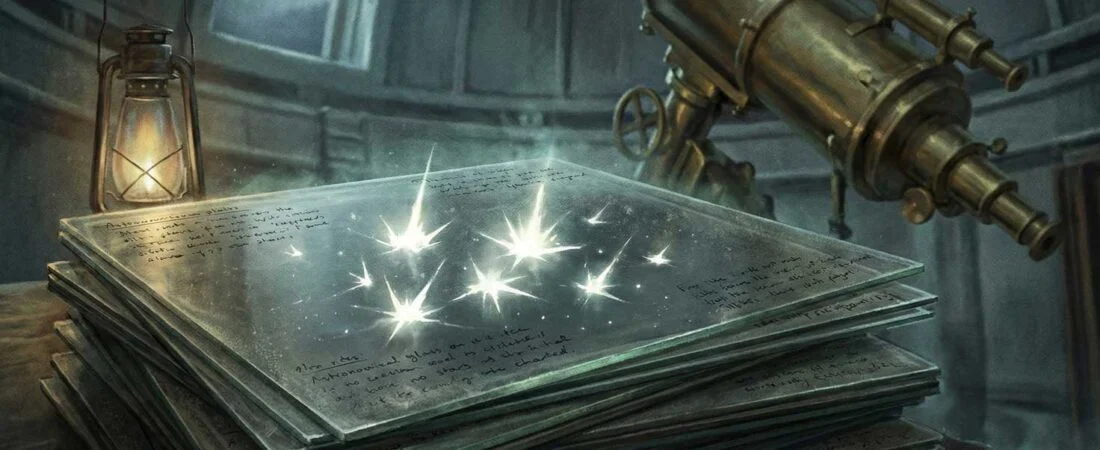
Sometimes the strangest mysteries are not discovered in the skies above us, but in dusty old archives that no one has touched in decades. That is exactly what happened when astronomers recently reexamined thousands of photographic plates taken between 1949 and 1958 at the famous Palomar Observatory. These plates were created long before digital detectors existed, back when the sky was captured on physical glass sheets coated with chemicals that reacted to starlight.
For seventy years, these images sat stored away, cataloged and forgotten. But when a team of researchers revisited them using modern scanning tools and pattern-detection software, they found something shocking. Scattered across multiple plates were bright, star like flashes that appeared out of nowhere and vanished just as quickly. Objects that shined for a brief moment, then disappeared. In some cases, the flashes formed timing clusters. In others, they showed up near the same coordinates at different points in time.
The study, published just yesterday, describes them as optical transients that defy conventional astrophysics. These transients seemed to emerge from empty space. They did not behave like meteors, satellites, known aircraft, or camera defects. Instead, they appeared suddenly, with clean sharp points of light, then vanished.
The scientists were careful, cautious, and thorough. They looked for chemical defects in the plates. They checked for dust, scratches, and processing errors. They compared exposures. They even scanned areas around each flash to see whether the pattern repeated elsewhere.
The conclusion reached by the research team was simple and unnerving: they cannot explain what the flashes were. The term they used was “no easy explanation.”
And that is where the story becomes much stranger.
When the timestamps on several of these flashes were compared to historical events, some lined up suspiciously close to Cold War nuclear tests. Not perfectly, not in every case, but enough to raise eyebrows in the scientific community. The late 1940s and 1950s were filled with military test detonations, secret projects, and the birth of the modern UFO era. Reports of strange lights in the sky surged across the United States during those years.
Now these plates show unexplained lights appearing right when the world was experimenting with destructive energy never seen before on Earth.
Skeptics insist that nuclear activity has nothing to do with the flashes. They argue that the timing is pure coincidence. But the pattern is hard to ignore. The earliest sightings of UFOs in American history came right after the first atomic detonations. Stories from that era describe glowing discs and fast moving lights that seemed to watch nuclear sites. Even government documents from the time note craft observed hovering over Air Force bases holding atomic weapons.
And now, tucked away in dusty storage, we find evidence that strange, bright, short lived objects appeared in the night sky during those same years.
So what exactly are these ghost lights?
One possibility is a new kind of atmospheric flash. Something caused by upper atmosphere reactions nobody understood back then. But this is unlikely, because the plates were taken at different times, different seasons, and with different scopes. Even more important, atmospheric flashes do not appear as sharp, clean points of starlight.
Another theory is an unknown type of spacecraft. Something artificial. Something moving in a controlled way, possibly testing or observing. But that theory opens a door that scientists hesitate to step through.
Then there is the nuclear connection. Some researchers believe the first atomic tests acted as a kind of beacon, drawing attention from beyond Earth. If anything out there was listening, the sudden burst of unnatural radiation might have caught it. The ghost lights could have been reconnaissance. Or something else entirely.
But to be fair, the researchers did offer more grounded explanations too. They considered the possibility that these flashes were caused by cosmic rays hitting the plates. High energy particles striking the film could create bright white points. The only problem is that cosmic ray marks usually leave streaks or distorted shapes. The flashes on the Palomar plates are round, crisp, and consistent, more like stars turning on and off instantly.
One of the most intriguing aspects of the discovery is that some plates show multiple flashes within minutes of each other. These are not random. They cluster. They appear, disappear, and reappear in ways that suggest timing rather than chance.
If this were only a single plate, scientists would dismiss it. But the team found similar transients across several years of data. Not many, but enough to make statistical noise unlikely.
This discovery has revived old rumors among astronomers. Quiet stories that some observatories in the 1950s and 1960s saw fast moving lights that were impossible to track. Stories usually whispered, not published. These new findings may push those whispers into the open.
There is something chilling about light that appears and disappears without warning. Something that feels alive, or at least intentional. A flash of awareness in the darkness. A brief signal from something we cannot see.
The researchers plan to search more observatory archives next. Hundreds of thousands of plates exist around the world. Most have never been digitized. Who knows how many ghost lights hide inside them?
If they find the same flashes in observatories from other countries and other eras, then these events may not be random at all. They could be signs of something consistent and ancient. Something watching. Something that has been moving above our planet long before digital cameras existed.
For now, the truth behind the ghost lights remains unknown. But the idea that the sky above us may have been busy with strange activity for decades — maybe longer — is impossible to ignore.
And all it took to rediscover it was a forgotten box of glass plates gathering dust in an archive.