
Listen on Spotify
Listen on Apple Podcasts
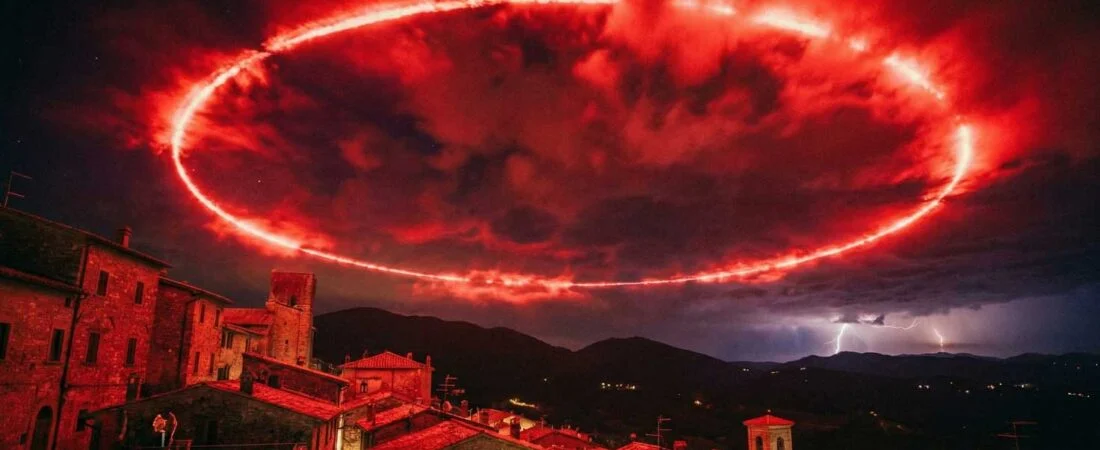
On the night of November 17, 2025, the quiet town of Possagno in northern Italy became the stage for one of the strangest atmospheric events captured this year. Above the rolling Alpine foothills, a massive red ring flashed into existence high in the sky. It was so large, so perfectly circular, and so intensely bright that people online immediately compared it to a UFO mothership descending through the clouds.
But the ring was not seen with the naked eye. It lasted only a fraction of a millisecond, far too fast for humans to detect without special equipment. Thankfully, one photographer had the right tools pointed at the sky at exactly the right moment.
His camera captured an enormous crimson disc hovering over the night sky, glowing like a burning doorway. The image looks so surreal that many assumed it was computer generated. But atmospheric scientists quickly confirmed it was real and identified it as a rare, powerful phenomenon known as an ELVE.
An ELVE, short for Emission of Light and Very Low Frequency Perturbations due to Electromagnetic Pulse Sources, is one of the rarest and most dramatic forms of upper atmosphere lightning. Unlike regular lightning, which dances close to the ground, an ELVE occurs up to 60 miles above the Earth, in the ionosphere. It is created when an extremely strong lightning strike releases a burst of electromagnetic energy that shoots upward instead of downward. When that energy hits the ionosphere, it creates a rapidly expanding ring of red light that can stretch more than 200 kilometers wide.
But what makes this event even stranger is that this is not the first time Possagno has seen something like this.
Back in 2021, the same region captured a nearly identical red ring. Same area. Same scale. Same shocking circular shape. Two massive ELVEs appearing over the same small Italian town within just a few years is an unusual pattern, and one that has caught the attention of both scientists and UFO watchers.
The photographer who caught the event, Valter Binotto, specializes in rare sky phenomena like sprites and elves. On the night of November 17, he was monitoring a storm more than 180 miles away, expecting intense lightning strikes. What he photographed instead was the kind of atmospheric event scientists only see a handful of times in a decade. His image shows a glowing red disc so perfectly symmetrical it looks artificial, like some colossal craft drifting silently in the sky.
What makes ELVEs eerie is their scale. They are enormous, wide enough to blanket entire cities. They flash into existence faster than human eyes can register. And they sit at the boundary between Earth and space, glowing against the curvature of the planet where our atmosphere thins into the void.
Even scientists who study ELVEs admit there is something otherworldly about them. They are silent, colossal, and almost never witnessed directly. Their circular shape adds to the mystery, giving them a distinctly technological appearance.
And because ELVEs occur above storms that are often too far away to be seen, the sky appears calm and peaceful while a massive circle lights up overhead. The result is a photo that looks nothing like normal lightning and everything like something engineered.
In Possagno, the appearance of a second ELVE has fueled speculation. Some locals wonder if the geography of the region might make it a hotspot for the electromagnetic pulses that trigger these events. Others believe it is more than coincidence and have begun to weave their own theories around the pattern.
Online, UFO researchers have seized on the imagery. The ring looks too clean, too structured, too perfect. Its diameter covers an area larger than many countries. Theories range from atmospheric portals to unusual energy emissions to the idea that lightning may be interacting with something above the clouds that we have not yet identified.
Scientists maintain that ELVEs are natural, though extremely rare. But there is still plenty we do not understand about the high altitude interactions that create them. Some researchers suggest that repeating ELVEs in the same region could hint at unique electromagnetic conditions in the ionosphere above certain parts of the world.
Even the name ELVE itself adds a touch of the supernatural, derived partly from folklore about mysterious beings of light.
One of the reasons ELVEs fascinate both scientists and the public is because they sit at the edge of our understanding. These events occur far above thunderstorms where the Earth’s atmosphere blends into space. They involve energy, speed, and scale beyond anything on the surface below.
The Possagno ELVE reached roughly 200 kilometers across in under one millisecond. That means its glowing ring expanded faster than any aircraft, meteor, or human-made object could ever move across the sky. It is a visual record of atmospheric forces at their most powerful and most mysterious.
For residents of Possagno, the sky that night looked normal. No rumbling thunder, no unusual light, no warning. But high above them, the atmosphere briefly opened a red circle of energy large enough to be seen from space. Only the long exposure lens of a skilled sky watcher caught the moment.
As more people see the photos, the line between science and mystery blurs. ELVEs may be natural, but their appearance triggers the same instincts that fuel UFO sightings: awe, curiosity, and the sense that we are witnessing something beyond normal experience.
And with two massive ELVEs hitting the same region in just a few years, people are watching the skies over northern Italy closely. Whether these events are simply rare atmospheric coincidences or signs of something more complex happening above our heads, one thing is clear.
The night sky still holds secrets, and sometimes those secrets reveal themselves in a flash of red light stretching hundreds of miles across.