
Listen on Spotify
Listen on Apple Podcasts
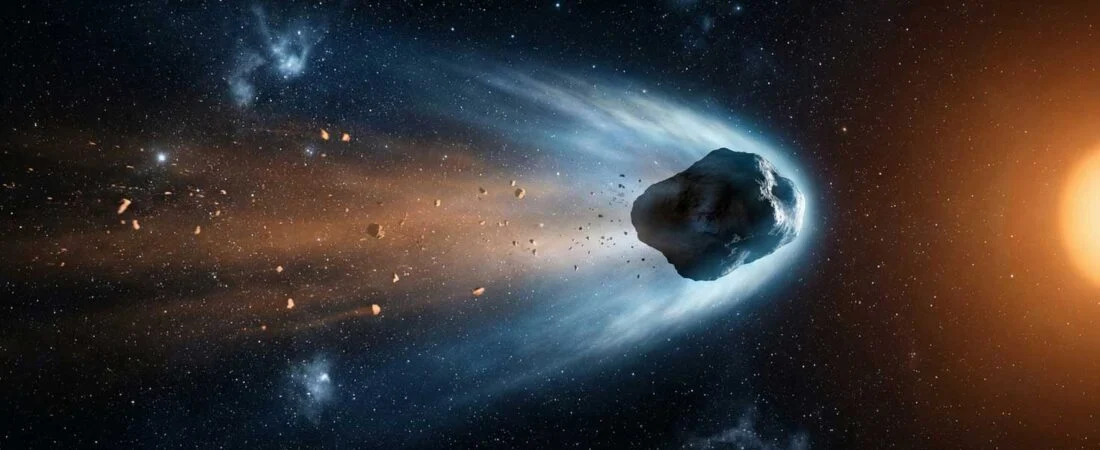
On December 2, 2025, a surprising new twist emerged in the case of 3I ATLAS, the interstellar object that has already puzzled astronomers with its strange acceleration, unusual brightening, and chemical oddities. This time, the shock came from updated observations showing that 3I/ATLAS appears to be followed by a faint “swarm” of objects behaving differently than the main body. Even stranger, these objects seem to create an anti tail that points toward the Sun instead of away from it.
The discovery comes from new analyses shared publicly by Harvard astrophysicist Avi Loeb, whose team noticed that recent images of 3I/ATLAS showed a teardrop shaped glow pointing inward, reversing the direction a comet tail should normally flow. A typical comet releases gas and dust that get pushed outward by solar radiation, forming a tail that stretches away from the Sun. But 3I/ATLAS is doing the opposite. Its glow points toward the Sun as if something behind it is reflecting light forward.
Loeb believes this shape may be created by a cluster of small fragments or companion objects traveling tens of thousands of kilometers closer to the Sun than 3I/ATLAS itself. These fragments do not show the same strange acceleration that 3I/ATLAS does. Instead, they follow a more natural gravitational path, creating a light scattering pattern that curves inward and forms the anti-tail.
The possibility of a companion swarm is not unheard of in astronomy. Comets frequently shed small pieces that drift behind them. But 3I/ATLAS has already shown behavior that does not match standard comet physics. Its acceleration cannot be fully explained by gas release alone. Its brightening after passing behind the Sun was far stronger than expected. And some of its chemical signatures suggest unusual or exotic material.
So, when an anti-tail appeared, astronomers took notice. And so did those who suspect 3I/ATLAS may not be a simple natural visitor.
The idea of a swarm introduces more questions than answers. If 3I/ATLAS is shedding fragments, why are those fragments not accelerating in the same strange way That would imply the main body has unique properties the smaller pieces lack. But if the swarm consists of unrelated objects that just happen to be nearby, the coincidence would be difficult to explain.
Companion objects can sometimes form from gravitational clustering, but 3I/ATLAS entered the solar system at high speed from outside the Sun’s influence. It should not have had a chance to collect followers. Which means one of two possibilities is on the table. Either the objects were already traveling with 3I/ATLAS long before it reached our solar system, or something happened near the Sun that created new structure around it.
Some have speculated that the swarm could be debris from a larger body that 3I/ATLAS broke away from in deep space. Others think the fragments may reveal something about how the object formed in the first place, perhaps as pieces of a larger interstellar structure or collision. But as always with strange visitors from beyond our star, the more exotic ideas have also begun to circulate.
During the Oumuamua debate several years ago, some researchers suggested the object could be artificial, possibly a thin lightsail powered by radiation pressure. 3I/ATLAS itself shows the same unexplained non gravitational acceleration that fueled those discussions. And if an object were artificial, fragments or companion structures might behave differently from the main body.
Most scientists prefer natural explanations, but even the natural options are unusual. A normal comet would not produce this kind of anti-tail so sharply, and it would not sustain such a shape unless multiple objects maintained a specific geometry relative to the Sun. The latest images show something structured, not random.
Loeb has urged caution but made it clear that the anti-tail is a real feature that requires explanation. His team is preparing more observations as 3I/ATLAS continues its outbound path away from the Sun. Each day offers a chance to capture new angles, new reflections, and new clues about what is happening in the space behind it.
If the swarm exists as a cluster of small bodies, they will dim at different rates than 3I/ATLAS. If the anti tail is created by dust release, the shape will shift as solar forces disperse the material. But if the structure remains stable over time, a more complex explanation may be needed.
This is not the first time 3I/ATLAS has behaved strangely. Earlier this year, after passing behind the Sun, it brightened nearly ten times more than expected. Most comets dim during this phase. 3I/ATLAS seemed to flare with energy. At the same time, its trajectory shifted in ways that do not match standard outgassing models.
The anti tail feels like the next chapter in an unfolding cosmic puzzle, one that mixes physics, chemistry, motion, and light into a story with no ending yet.
For listeners of The Oddity Files, this moment mirrors the excitement and uncertainty of the Oumuamua era. An object from outside our solar system has arrived carrying mysteries we do not yet understand. It brightens when it should dim. It accelerates when physics says it should coast. It carries what might be a swarm of smaller bodies. And now it displays a tail that points the wrong direction.
Whatever 3I/ATLAS is, it is not ordinary.
If the swarm proves real, astronomers may uncover a completely new category of interstellar object, one that travels with fragments or companions across vast distances. If the anti tail has a natural explanation, we will learn something new about how dust behaves in complex gravitational fields. And if none of the standard models fit, the conversation may expand into territory as strange as the object itself.
For now, 3I/ATLAS continues to move outward, its teardrop shaped glow shifting as angles change and sunlight refracts through whatever surrounds it. The coming weeks will reveal whether the anti-tail fades or strengthens, and whether more fragments become visible as the object cools.
In a universe full of mysteries, an interstellar visitor with a mind-bending tail may be the most captivating surprise of the year. And once again, the question lingers. What exactly is traveling through our solar system, and what story will it leave behind when it vanishes into the dark?