
Listen on Spotify
Listen on Apple Podcasts
A universe made of code?
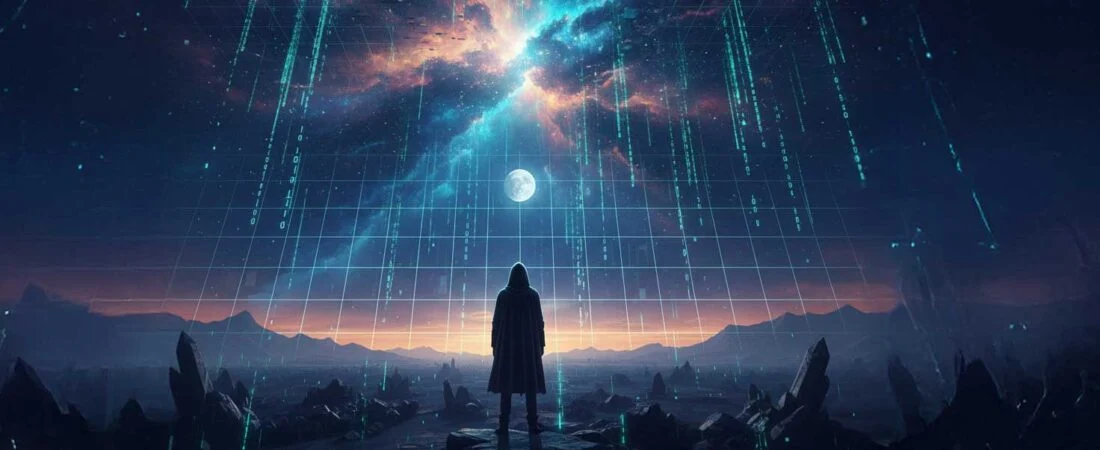
What if everything you see—every star, sound, and heartbeat—isn’t real in the way you think it is? What if the universe itself is a simulation, a vast computer program created by an intelligence far beyond our own?
This question, once confined to philosophy and science fiction, is now the subject of serious scientific debate. The simulation hypothesis suggests that our reality may not be physical at all, but rather a digital construct, complete with mathematical rules, encoded data, and perhaps even hidden errors—glitches in reality.
Physicists, philosophers, and technologists are now exploring whether the clues to our existence are written not in atoms, but in algorithms.
The spark: Bostrom’s trilemma
The modern simulation debate began in 2003 with philosopher Nick Bostrom from the University of Oxford. In his now-famous paper, Are You Living in a Computer Simulation?, Bostrom proposed what’s known as the simulation trilemma.
It goes like this: one of three statements must be true.
- Almost all civilizations go extinct before reaching a technological level capable of simulating reality.
- Advanced civilizations could run simulations, but they choose not to.
- We are almost certainly living in a simulation.
If future civilizations develop enough computing power to simulate conscious beings, Bostrom argued, then statistically, it’s far more likely we’re inside one of those countless simulations rather than the single “base reality.”
Enter the scientists
While philosophers debated ethics and existential dread, some physicists began searching for measurable evidence. Could the universe leave digital fingerprints? Could we find mathematical proof that our world is code-based?
One of the most intriguing voices in this field is Dr. Melvin Vopson, a scientist who believes he may have uncovered the first physical evidence pointing toward a digital universe.
Vopson proposes the Second Law of Infodynamics, a theory suggesting that all systems, including the universe itself, naturally evolve toward minimizing information complexity. In other words, the cosmos may be “optimizing its data” the same way a computer program compresses files.
He argues that the universe doesn’t just conserve energy—it conserves information. Every particle, every law of physics, could be part of a vast computational system striving for efficiency.
To Vopson, this optimization is a sign that the universe might not be random matter but a self-regulating digital code.
Searching for glitches in the code
If reality is a simulation, where are the errors? Proponents point to strange phenomena that behave like digital anomalies—glitches in the cosmic code.
Quantum mechanics, for example, shows that particles don’t exist in a definite state until they’re observed. To some, this resembles how a video game only renders what the player is currently looking at, conserving computing power by generating environments on demand.
Others point to the Planck length—the smallest measurable unit in the universe—as evidence of a finite “resolution,” a pixel size of spacetime. If the universe were continuous and analog, there would be no such limit.
Even the speed of light could be viewed as a kind of cosmic processing speed limit, the maximum rate at which information can be transmitted through this grand simulation.
The counterargument: physics beyond computation
But not everyone is convinced. A growing number of scientists argue that reality cannot be reduced to computation. Using Gödel’s incompleteness theorems, some physicists claim that the universe contains truths that no algorithm could ever express.
Gödel proved that in any formal system—like mathematics—there will always be truths that can’t be proven within that system. Applied to physics, this means the laws of the universe might extend beyond what any simulated or computational model could ever calculate.
In other words, if our universe contains non-algorithmic truths, then it cannot be a simulation. No program, no matter how advanced, could perfectly reproduce a reality containing phenomena that transcend computation itself.
Dr. Hector Zenil, a researcher in algorithmic information theory, explains it this way: “If you can predict every outcome, you’re in a computation. But nature doesn’t let us do that. It’s not scripted—it’s creative.”
A paradox we can’t escape
Both sides of the debate raise a paradox. If we are in a simulation, could we ever prove it? If we’re not, could we ever rule it out?
Proponents suggest that discovering the “source code” of the universe—perhaps hidden in the fine structure of physical constants or cosmic background radiation—could provide proof. Others think any attempt to expose the simulation would be prevented by design, like a built-in safeguard to protect the integrity of the program.
Some even theorize that quantum entanglement—the mysterious link between particles across space—might represent a kind of background network connecting all points in the system, similar to how servers communicate across the internet.
But skeptics say this kind of thinking risks turning science into mythology. “We can’t label every unknown as a glitch,” one researcher warned. “Otherwise, we stop looking for real explanations.”
Ethical and existential questions
If the simulation hypothesis were ever proven true, it would upend philosophy, religion, and science in a single stroke.
Would our lives still have meaning if we’re digital constructs? Who—or what—created the simulation, and why? Are we experiments, entertainment, or something else entirely?
Nick Bostrom himself has expressed discomfort with the implications. “If we are simulated,” he once said, “then our creators would have the same ethical responsibility toward us that we have toward sentient beings in our world.”
Some scientists even speculate about communication—whether we could send a signal back to the programmers, asking for a response. Others wonder if near-death experiences, déjà vu, or unexplained synchronicities could be signs of interaction from “outside” the system.
Reality redefined
Whether the universe is real, digital, or something in between, one truth remains: the more we study reality, the stranger it becomes.
Physics and philosophy continue to blur, and every discovery brings us closer to an uncomfortable realization—that understanding existence may mean questioning its very foundation.
If the universe is code, it’s the most sophisticated one ever written. If it’s not, it’s still more mysterious than we can comprehend.
Either way, the search for truth continues—and maybe, just maybe, the next great scientific breakthrough won’t come from the stars, but from the glitches in reality that hide in plain sight.