
Listen on Spotify
Listen on Apple Podcasts
Rethinking the extraterrestrial
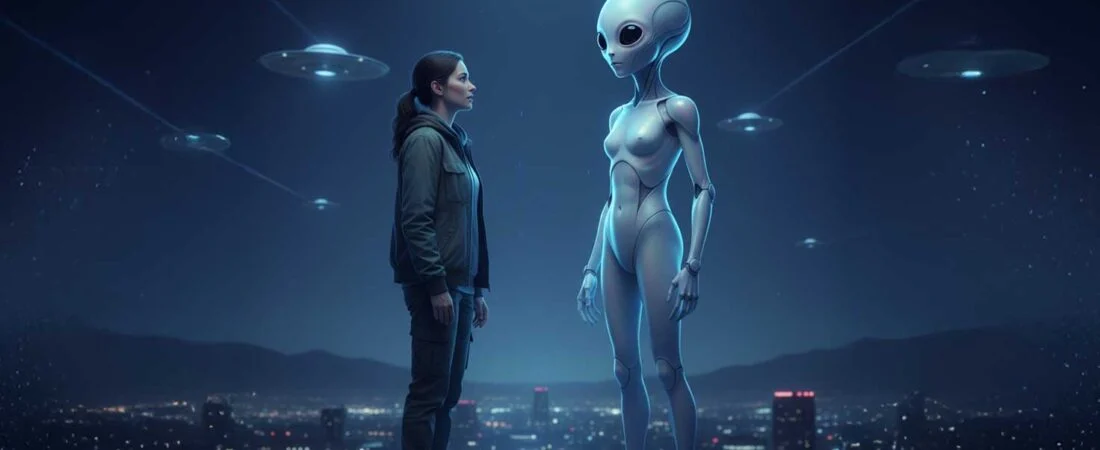
When people imagine aliens, they picture something utterly foreign. Grey skin, huge eyes, elongated skulls, and minds beyond human understanding. But what if those beings aren’t foreign at all? What if they’re not visitors from distant stars, but travelers from our own future?
That’s the idea proposed by Dr. Michael Masters, a biological anthropologist who believes that alleged extraterrestrials and the crafts they travel in may actually be evolved humans—descendants returning from a far-off timeline to study their past.
This theory, known as the Future Human Hypothesis, doesn’t dismiss UFO encounters. Instead, it reframes them through biology, evolution, and time.
The future human hypothesis
Dr. Masters approaches the UFO mystery like a scientist, not a storyteller. He points out that the beings described in thousands of close encounter reports share eerily human traits: upright posture, bilateral symmetry, bipedal movement, two eyes, a nose, a mouth, and hands capable of fine manipulation.
If life evolved under completely different conditions, he argues, it likely wouldn’t resemble us at all. So why do so many eyewitnesses describe beings that look like distorted versions of ourselves?
According to Masters, evolution doesn’t stop with us. He suggests that in the distant future, humans may develop larger skulls, smaller faces, and bigger eyes—features consistent with both reported aliens and our own evolutionary trajectory toward brain expansion and increased reliance on vision and technology.
In his view, the so-called “greys” might not be aliens from another world, but humans who have mastered time travel and returned to study their origins.
Science meets speculation
Skeptics dismiss time travel as fantasy, but modern physics doesn’t entirely rule it out. Einstein’s theory of relativity allows for time dilation—where time flows differently depending on speed and gravity. Wormholes, if they exist, could theoretically bridge points in space and time.
Dr. Masters doesn’t claim to know how it works, only that the patterns in UFO encounters align more closely with anthropology than astrophysics. “If these entities were extraterrestrial,” he argues, “we’d expect more biological diversity. But the reports are remarkably consistent, almost as if we’re looking at future versions of ourselves.”
To him, UFOs aren’t alien invaders but time machines—devices built not for conquest, but for observation.
A personal encounter
Dr. Masters is not just a researcher of the unexplained; he’s also experienced it. During interviews, he’s shared personal accounts of strange lights and phenomena that shaped his curiosity about UAPs. Like many scientists who explore the unknown, he walks a careful line between evidence and belief, refusing to sensationalize what he can’t prove.
His willingness to speak publicly about these experiences is rare in academia, where UAP research still carries stigma. “There’s a real risk to your career,” he admits. “Scientists who take this topic seriously are often dismissed or ridiculed, even when the data demands attention.”
The whistleblower who spoke up
That stigma is something David Grusch, a former intelligence officer, knows all too well. Grusch made headlines when he alleged that the U.S. government has been running a secret program to recover and study non-human craft.
Soon after, he faced a deeply personal violation. A sheriff’s department illegally released his private mental health records, sparking a public battle that threatened to overshadow his claims. Grusch filed a lawsuit, and his supporters argue that the leak was meant to discredit him—a warning to others who might come forward.
For researchers like Dr. Masters, Grusch’s story underscores a troubling truth. Those who challenge official silence about UAPs often pay a heavy price.
Breaking the taboo
Both Masters and Grusch represent different sides of the same phenomenon. One is a scientist trying to understand what people are seeing. The other is an insider claiming to know what the government is hiding. Both have faced skepticism, hostility, and ridicule.
The common thread between them is not just curiosity, but courage. Talking about UAPs still risks a career, a reputation, or worse. The label of “conspiracy theorist” is often applied long before evidence is considered.
Yet the conversation is changing. Governments have begun releasing declassified footage. Congress has held hearings. Scientists once hesitant to speak are now asking bold questions. And with every disclosure, the gap between science fiction and reality grows smaller.
The human pattern
What makes the future human hypothesis so fascinating is how neatly it ties the mystery back to us. If UFOs are truly time machines, then we’re not being visited by outsiders—we’re being studied by our descendants.
That could explain why these encounters often involve biological sampling, hybridization stories, and behavior resembling field research. Anthropologists today study ancient bones, fossils, and artifacts. Future humans might be doing the same, only in reverse—returning to observe their own evolutionary past.
Even reports of abductions could be reinterpreted as scientific study, conducted without consent but not necessarily with malice. “To them,” Masters theorizes, “we might be as distant as Neanderthals are to us.”
Between wonder and warning
The idea that “aliens” are future humans is both comforting and chilling. It suggests continuity, survival, and intelligence lasting into deep time. But it also raises questions about destiny.
If these beings are our descendants, what do their visits say about our timeline? Are they here to study a turning point in human history—perhaps a moment when technology, climate, or conflict reshaped civilization?
Maybe their presence is not random at all. Maybe we are the era they return to most.
A new paradigm
Whether one believes in Grusch’s testimony or Dr. Masters’ theory, both point to the same conclusion. The mystery of UFOs is no longer just about lights in the sky. It’s about identity. Who we are. Who we were. And who we might become.
Science fiction has always dreamed of meeting extraterrestrials. But what if, when that meeting finally happens, the face staring back at us is our own?