
Listen on Spotify
Listen on Apple Podcasts
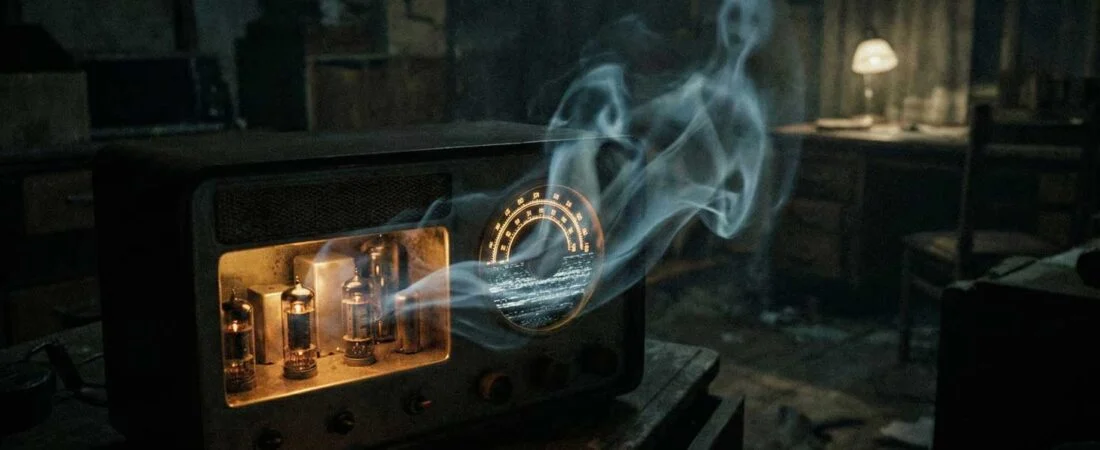
Shortwave listeners know the sound.
A burst of static.
A mechanical voice.
A long pause.
Then the counting begins.
For decades, these strange broadcasts known as number stations have puzzled radio operators and spy enthusiasts alike. Most people have never heard them, but for those who tune into the forgotten edges of the airwaves, they are one of the oldest unsolved mysteries in modern communication.
A cold, emotionless voice reading strings of numbers to no one and everyone at the same time.
Five.
Seven.
Two.
Nine.
Nine.
Pause.
Repeat.
But many of these stations have gone dark in recent years. Entire channels that once carried eerie tones and coded messages have fallen silent as the world moved away from analog espionage. At least, that is what listeners believed.
Until now.
Recently, a long defunct number station suddenly came back on the air. No warning. No announcement. Not even the same voice. The broadcast simply activated again with a slightly altered tone and a new sequence of numbers. The transmission was faint at first, breaking through layers of static, but unmistakable. The signature pattern was the same. The station had returned.
Shortwave hobbyists immediately recognized the frequency. They had monitored it for years, waiting for signs of life, long after everyone assumed it had gone silent forever. And when it came back, it returned with something extra. Something unsettling.
Hidden beneath the static, listeners reported faint noises that did not belong to any known transmission pattern. Some described it as whispering. Others said it sounded like distant voices layered under the number stream. A few insisted they heard words, but no two listeners could agree on what they were.
That is when the questions started.
Number stations are believed to be used by intelligence agencies to communicate with undercover operatives. A string of numbers read over an anonymous carrier wave can deliver encoded instructions that only a specific agent with a one time pad can decode. The method is nearly untraceable and impossible to break without the matching cipher.
But this station was believed to be dead for years. Its reappearance raises more questions than answers.
Why did it go silent?
Why return now?
Why change the voice?
And what is hiding under the static?
Number stations first appeared during the Cold War. They broadcast from Soviet territories, Cuban intelligence sites, European safehouses, and other clandestine locations. Some used artificial voices. Others used children. A few played strange tones or musical stingers before the numbers began. One of the most famous, known as “The Lincolnshire Poacher,” opened every broadcast with a jaunty folk tune that echoed eerily across the airwaves.
These stations were never acknowledged by governments. Yet everyone knew they existed.
During major world events, number stations often changed abruptly. New codes. Faster transmissions. Different frequencies. So when an old station returns suddenly, radio monitors pay attention. It could mean tensions somewhere are rising. An operation has reactivated. Or someone is trying to contact operatives long thought retired or lost.
But the whispers beneath the numbers complicate things.
Some listeners believe the hidden audio is simply interference from adjacent frequencies. Others point out that the patterns do not match typical radio bleed. The suspected whispers appear only between the number sequences, too rhythmic to be random and too low to be simple noise.
And then there are the theories that lean into the strange.
What if the transmission was never meant to be found?
What if someone is piggybacking messages under the number sequence?
What if the whispers are not human voices at all?
It sounds dramatic, but unexplained radio transmissions have a long history in paranormal research. Mysterious signals, ghostly voices, and odd anomalies are often reported on abandoned frequencies. Some paranormal investigators believe certain types of electromagnetic activity can capture or echo human voices, like a cosmic recorder that plays back fragments of sound long after the speaker is gone.
The possibility that this number station is carrying an accidental “recording” from somewhere else only deepens the mystery.
Others point to intelligence remnants from decades past. Was this station part of an old spy network that was reactivated? If so, why now? Some geopolitical analysts believe the sudden resurgence could reflect modern tensions, cyber conflicts, or covert operations rekindled behind the scenes.
There is also the darker theory.
What if the station never belonged to any known intelligence agency?
Some researchers argue that a handful of number stations have origins that do not match any documented government source. These outliers are rare but have puzzled experts for nearly forty years.
If this returning station is one of those anomalies, its reactivation becomes even more mysterious.
Shortwave radio is one of the last truly anonymous tools left in global communication. Anyone, anywhere, with the right equipment can broadcast a message across continents. It requires no account, no internet, and no traceable footprint. That anonymity is both powerful and unnerving.
Which brings us to the final question.
Who is meant to hear this broadcast now?
Since its reappearance, monitoring groups have logged multiple transmissions. The voice is cold, synthetic, and precise. The numbers follow a pattern researchers have not yet broken. And the faint sounds beneath the sequence continue, impossible to isolate cleanly.
Experts say the return of this station is either harmless, a nostalgic artifact blinking back to life, or a signal that something is happening in the shadows of global communication.
Amateur listeners say it feels different this time. Not random. Not mechanical. Something more deliberate.
Whatever the truth is, the dead station is alive again. Reading its numbers into the void. Whispering secrets through static. Waiting for someone, somewhere, to listen.
And tonight, we are listening too.