
Listen on Spotify
Listen on Apple Podcasts
Hollywood horror films often borrow pieces of truth from the real world, but few stories have roots as unsettling as the Herman Poltergeist case of 1958. This haunting, which erupted inside a quiet suburban home in Seaford, New York, is one of the most documented and chaotic outbreaks of paranormal activity in American history. Long before it inspired scenes for the movie Poltergeist, it terrified a family, baffled police officers, and drew reporters who witnessed inexplicable events with their own eyes.
The nightmare began on February 3, 1958, when the Herman family returned home after school and work. Twelve year old Lucille went to get a drink and noticed something strange: several bottles in the bathroom had popped their caps. The bottles were sitting peacefully, untouched, yet their tops lay scattered around the room. Minutes later, the same thing happened in the kitchen. Then again in the basement. Over the next few hours, at least thirty different bottles popped their caps or spilled their contents without anyone near them.
At first, the family blamed temperature changes or faulty seals. But then the activity escalated.
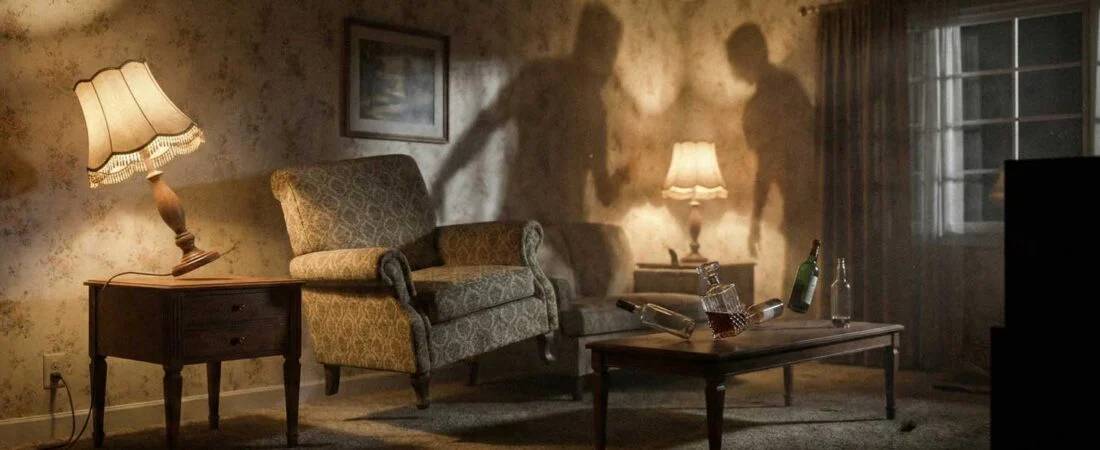
Within two days, objects began flying off shelves. A heavy bookcase shuddered violently as if pushed from behind. A table lamp flipped over on its own. The Hermans heard knocks in the walls, rhythmic and deliberate, like someone was trying to get their attention. They called police, convinced that someone had broken in. Officers searched the home and found nothing out of place. No intruder. No damage. No footprints. And no explanation.
Then the activity returned while the police were still there.
A porcelain figurine slid across a table. A bottle on the kitchen counter tipped and fell. No one was near either object. The officers were stunned. One of them suggested a prank, but the Hermans insisted the kids were not responsible. Even if they had been, no one could have planned the sudden, violent movements of objects the kids were nowhere near.
Word spread quickly. Reporters, skeptics, neighbors, and even scientists began visiting the house. Some arrived expecting to debunk the entire thing. Others came hoping to witness something extraordinary.
But what they saw was worse.
Bottles burst without warning, sometimes spraying liquid across the room. A globe spun by itself. Cushions collapsed as if someone invisible had sat down. Toys rolled in patterns no one could explain. Officers witnessed doors opening without hands. A religious statue toppled for no discernible reason.
Soon, the haunting seemed to center on the Herman’s teenage son, Jimmy. When he walked through a room, objects would tremble or shift. Some researchers suspected that the energy was somehow connected to him, even though he showed no signs of trickery and was often across the room when events occurred.
Parapsychologists arrived next. Dr. J. B. Rhine, famous for his work in extrasensory perception at Duke University, sent one of his researchers to observe the Herman home. Their conclusion was startling: although the researchers could not prove a spirit was involved, the events were genuine. They ruled out drafts, vibrations, structural issues, and the possibility of strings or magnets. Something unseen was interacting with the physical world.
The case grew stranger.
Over the next two weeks, heavier objects began to move. A massive wooden dresser shifted several inches from the wall. A nightstand slid across the floor. And in one of the most chilling events, a large plant lifted from the ground and tipped over mid air, landing several feet away. When witnesses inspected the soil, they found no sign that the plant had been dragged.
By now, national news outlets were following the story. Reporters camped outside the house, trying to catch evidence themselves. Some did. A few described seeing objects wobble, fall, or even bounce with an invisible force.
Then, as suddenly as it began, the activity slowed.
The Hermans moved their children temporarily to a relative’s home in hopes of calming the disturbance. The quieter environment helped. Within days, the activity in the Herman home dropped to nearly nothing. After a few weeks, it stopped entirely.
To this day, no one knows what caused the outbreak.
Some believe the energy came from Jimmy, triggered by puberty and stress, manifesting as psychokinetic bursts. Others suspect an external spirit or presence attached to the family or the home. Skeptics insist it must have been a prank, although no evidence of fraud was ever found, and dozens of witnesses — including police — observed the events firsthand.
The haunting lasted less than a month, yet its impact has lasted generations. It remains one of the most documented poltergeist cases in American history. The chaos, the speed of escalation, and the large number of credible witnesses make it a cornerstone case for paranormal researchers worldwide.
And perhaps the eeriest part is how ordinary the house appeared from the outside: a peaceful suburban home on a quiet street, holding a storm of invisible energy within its walls.
Even now, decades later, paranormal investigators revisit the Herman case because of its intensity and credibility. It is a reminder that sometimes the most terrifying hauntings happen not in ancient castles or abandoned hospitals, but in the most ordinary places — behind doors that look just like the ones in your own neighborhood.
The Herman Poltergeist was more than a haunting. It was a disruption of reality, a moment where the unseen world stepped boldly into the light, refusing to be ignored.
And whatever moved through that house in 1958 left behind a legacy of fear, fascination, and unanswered questions that still echo today.