
Listen on Spotify
Listen on Apple Podcasts
When imagination crosses into the unknown
It began the way most ghost stories do—not with flickering lights or whispering shadows, but with something innocent. A toddler. A mother. And a quiet house that seemed perfectly ordinary—until it wasn’t.
Kate Haas thought nothing of her baby’s distant stares. Like many parents, she assumed her son’s fascination with empty corners and unseen spaces was simply curiosity. Babies see the world differently, after all. But as the years passed and her little boy found his voice, those quiet moments took on a darker edge.
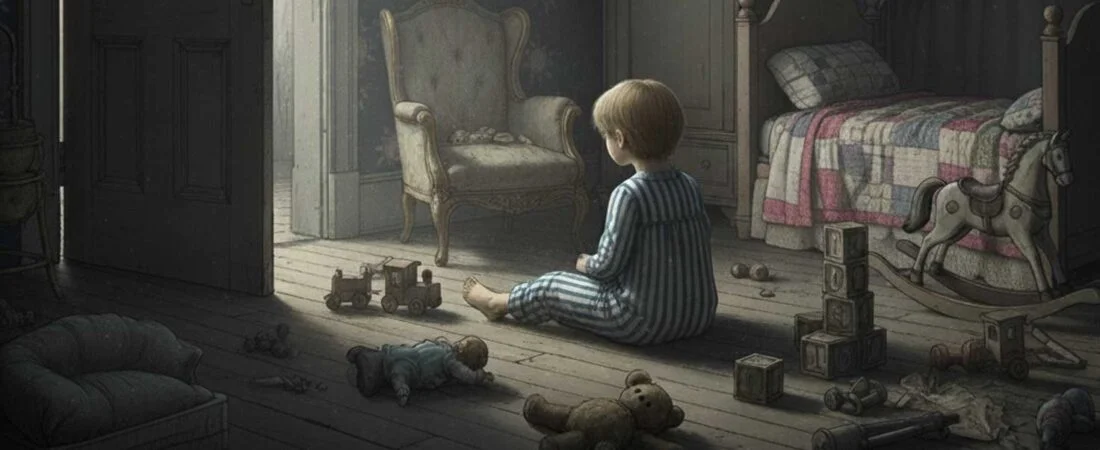
He began talking about someone named Toddy Ro—an “imaginary friend” who, according to the boy, lived in the house with them. Toddy Ro wasn’t a cartoon character or a neighbor’s child. He was just there. Somewhere in the house. Watching. Waiting.
At first, Kate laughed it off. Parents are told that imaginary friends are common, even healthy—a sign of creativity, not cause for alarm. But then her son said five words that stopped her heart cold:
“Mommy, Toddy Ro is here.”
The spirit in the nursery
The house they lived in was old—one of those creaky, charming homes with slanted floors and whispering vents that seemed to breathe when the wind hit just right. In daylight, it was cozy. At night, it hummed with history.
Kate couldn’t shake the feeling that maybe—just maybe—her son saw something she couldn’t. When the toddler’s eyes would fix on an empty spot, as if following an invisible guest, the air seemed to change. The house held its breath.
She tried to rationalize it. Maybe it was the way sunlight filtered through the window blinds, flickering like movement. Maybe it was dust caught in a stray beam of light. Or perhaps her son’s young mind was piecing together fragments of imagination and reality in the only way a three-year-old could.
But the name—Toddy Ro—was so specific, so strange, it didn’t feel like something he could have invented.
Children and the unseen world
Across cultures and centuries, stories abound of children who see beyond the veil. Literature, folklore, and paranormal research alike paint children as sensitive conduits to things adults have long tuned out.
Why? Maybe because children don’t yet know what’s “impossible.” Their minds are open. Their world is still filled with wonder—and with it, the potential to glimpse what lies unseen.
Even modern surveys echo this belief. Nearly half of Americans say they believe in ghosts. And while science often points to logical explanations—sleep paralysis, pareidolia, neurological quirks—many of us can’t help but feel that strange pull when something brushes the edge of the rational.
Kate Haas, to her credit, stayed skeptical. She searched for meaning in psychology, not the supernatural. But she also admitted that the story stuck with her. Even years later, when her son had grown up and forgotten all about Toddy Ro, Kate still remembered the name, the moment, and the chill that ran through her.
Between imagination and haunting
There’s something hauntingly universal about a child’s imaginary friend. On one hand, it’s adorable—a sign of innocence. On the other, it’s unsettling. Who, exactly, are they talking to when no one else is in the room?
Psychologists say imaginary friends are a tool for emotional development. They let children process complex feelings, fears, or loneliness. Yet, for parents, those invisible playmates can feel like unwelcome guests.
In Kate’s story, Toddy Ro was never malicious. He didn’t whisper threats or knock things off shelves. He simply existed. Quietly. Present enough to feel real, but intangible enough to deny.
The real haunting, it seems, wasn’t in the house—it was in the memory. The mystery that refused to fade, even when reason demanded it should.
The ghost that memory keeps alive
When Kate’s son went off to college, she finally told him the story of Toddy Ro. He looked confused. He had no memory of the name, no recollection of ever having an imaginary friend. For him, it was just another childhood blank space—one of those moments the brain files away and loses forever.
But for Kate, it was different. She’d told the story enough times that it had taken on a life of its own. Not a ghost story meant to frighten, but one that made people wonder. About consciousness. About the limits of perception. About the small, unexplained moments that make us question what’s real.
And that’s the beauty of stories like this—they remind us how thin the line is between logic and mystery. We don’t need cold spots or slamming doors to feel haunted. Sometimes, it’s enough to hear a child whisper a name that no one taught them.
Maybe some stories aren’t meant to be solved
Whether Toddy Ro was a fragment of imagination or something else entirely, the tale endures because it touches something primal. Every parent who’s ever seen their child staring into empty air has felt it—that flicker of curiosity and dread.
We crave explanations. But sometimes, the unknown is the point.
As Kate Haas concluded, maybe it doesn’t matter whether Toddy Ro was real. What matters is that he felt real. That, for a brief and unforgettable moment, the ordinary became extraordinary—and a mother glimpsed the possibility that her child’s mind might hold keys to a world just out of reach.
And so, she keeps telling the story. Not to convince anyone. Not to chase ghosts. But because, deep down, every good haunting begins not with fear, but with wonder.
Maybe Toddy Ro was never in the house. Maybe he’s just in the story now—living on in the retelling, haunting the edges of belief, and reminding us that sometimes, the most unsettling encounters happen not in dark hallways… but in the imagination of a child.